

Many patients who undergo a coronary angiogram are shocked when they hear the term Chronic Total Occlusion (CTO).
A CTO means that one of the heart arteries is completely blocked, often for several months or even years. Traditionally, patients with a totally blocked artery were often advised to undergo Coronary Artery Bypass Grafting (CABG) — commonly known as heart bypass surgery.
However, with modern advancements in cardiology, bypass surgery is no longer the only option for some patients. In many cases, CTO angioplasty (CTO PCI) may offer a less invasive treatment alternative.
Understanding the available options can help patients make more informed decisions about their heart health.
What is Chronic Total Occlusion (CTO)?
A Chronic Total Occlusion occurs when a coronary artery becomes completely blocked for more than 3 months.
This blockage is usually caused by the gradual build-up of:
- Cholesterol plaque
- Calcium deposits
- Scar tissue within the artery
Because the blockage develops slowly, the body may sometimes create small natural bypass channels known as collateral vessels to supply blood to the heart muscle.
Despite this, many patients may still experience symptoms such as:
• Chest pain or chest tightness (angina)
• Shortness of breath during physical activity
• Reduced exercise tolerance
• Fatigue with exertion
Some patients may also have silent CTO, meaning they have few symptoms but the heart muscle may still be under stress.
Traditional Treatment: Heart Bypass Surgery
For many years, the standard treatment for CTO was Coronary Artery Bypass Surgery (CABG).
During this surgery, doctors use a blood vessel from another part of the body to create a new pathway for blood to flow around the blocked artery.
Bypass surgery is a highly effective treatment and remains important for certain patients, especially when there are multiple blocked arteries or complex disease.
However, it is also a major surgical procedure that involves:
- Opening the chest
- General anaesthesia
- Several days of hospital stay
- Weeks of recovery time
For some patients, surgery may not be ideal due to age, medical conditions, or personal preference.
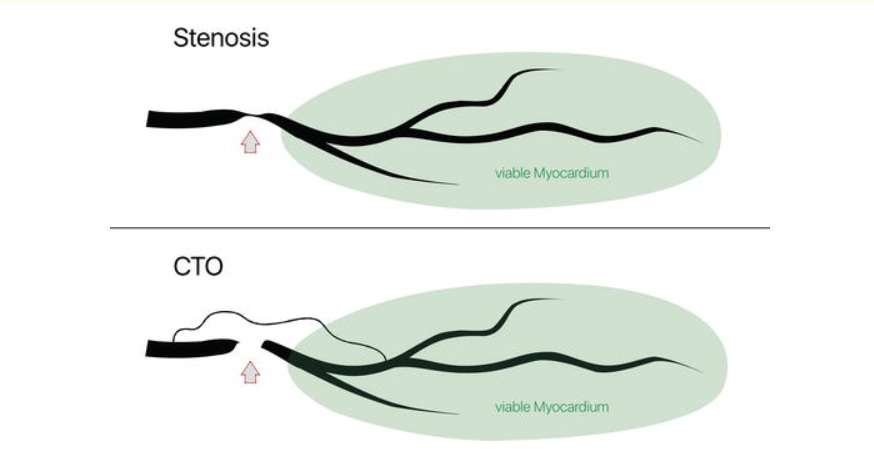
Modern Treatment Option: CTO Angioplasty (CTO PCI)
With advances in technology and expertise, cardiologists can now treat many CTO blockages using Percutaneous Coronary Intervention (PCI), commonly known as angioplasty and stenting.
During a CTO PCI procedure:
- A small catheter is inserted through an artery in the wrist or groin
- Specialised guidewires are used to carefully cross the blocked artery
- Balloons are used to open the blockage
- A coronary stent is placed to keep the artery open
Modern CTO procedures may involve advanced techniques such as:
• Dedicated CTO guidewires
• Microcatheters
• Retrograde approaches through collateral vessels
• Intravascular imaging (IVUS or OCT)
In experienced centres, success rates can reach 85–90% or higher.
Benefits of CTO Angioplasty
For carefully selected patients, CTO PCI may provide several advantages:
✔ Relief of chest pain
✔ Improved exercise capacity
✔ Better quality of life
✔ Avoidance of open-heart surgery
✔ Shorter recovery time
Most patients are able to return home within 1–2 days after the procedure.
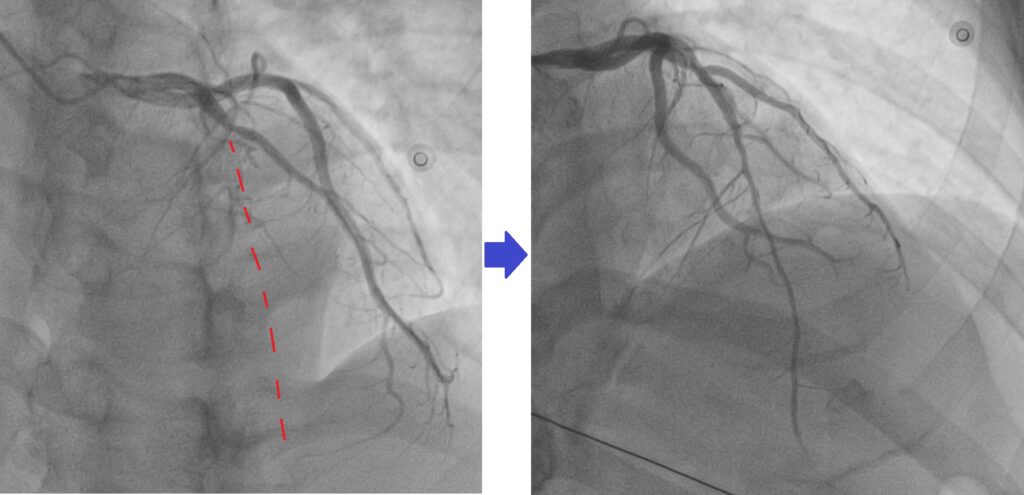
Example of my patient who has CTO LAD, there should be a vessel dictated by the red line. After opening the CTO, u can see coronary blood flow to the vessel.
Is CTO Angioplasty Suitable for Every Patient?
Not all CTOs require treatment, and not every blockage can be treated with angioplasty.
The best treatment approach depends on several factors:
• Severity of symptoms
• Amount of heart muscle at risk
• Complexity of the blockage
• Overall patient health
• Presence of other coronary artery disease
A discussion between cardiologists and cardiac surgeons — often called a Heart Team approach — helps determine the most appropriate treatment strategy.
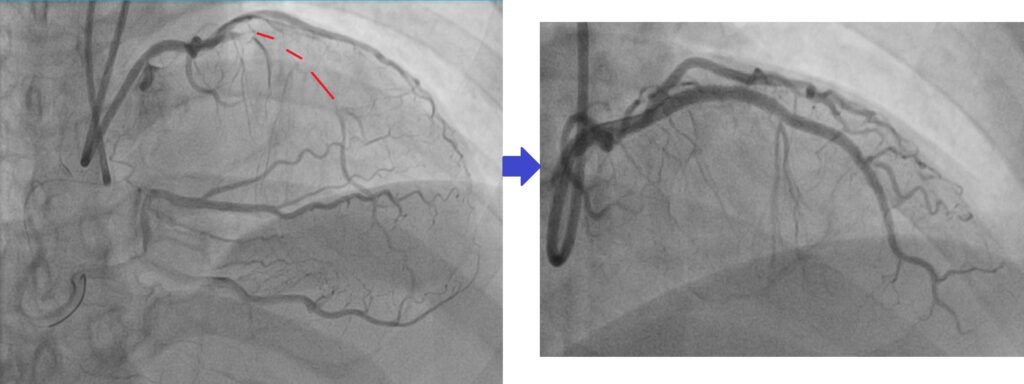
A patient of mine with CTO LAD as shown with red dotted line, after opening the CTO, can see flow to the coronary vessel.
Important Message for Patients
If you have been diagnosed with a Chronic Total Occlusion, it is important to know:
It is not necessarily the end of the road for your heart artery.
While bypass surgery remains an excellent option for many patients, CTO angioplasty may offer a safe and effective alternative for selected individuals.
Patients are encouraged to discuss all possible treatment options with their cardiologist before making a decision.
Expert Heart Care in Johor Bahru
Patients with complex coronary artery disease, including CTO, should seek evaluation by an experienced cardiologist.
Dr Lim Wei Juan
Consultant Cardiologist
KPJ Johor Specialist Hospital
Dr Lim is experienced in the management of coronary artery disease, angioplasty and complex coronary interventions, including CTO cases.
Early consultation allows patients to explore the most appropriate treatment options tailored to their individual condition.